

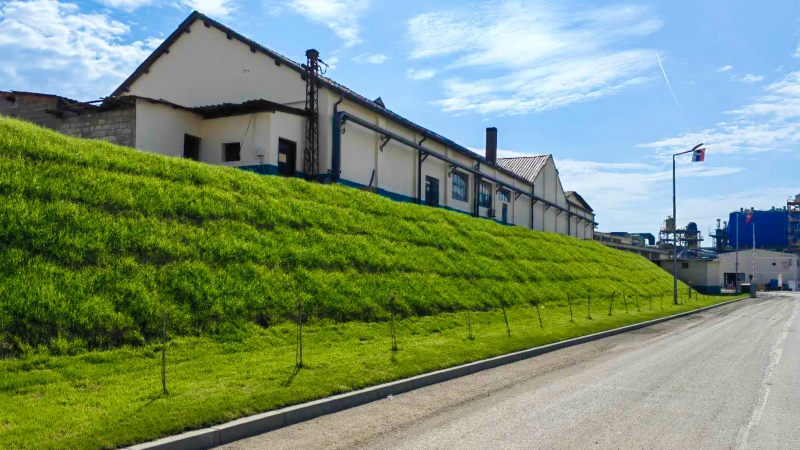
Serbia Zijin Copper’s TIR Smelter
“I’ve worked at the smelter for more than 20 years. In the past, the air was thick with smoke, and I could smell the stench even with a gas mask on,” recalled an engineer at Serbia Zijin Copper’s TIR smelter. Bare hills, grey plant premises, and a city shrouded in haze — that was the daily reality of the century-old mining town of Bor.
Facing severe legacy environmental problems at the Bor Copper Complex, which comprises the smelter and several copper mines, Serbia Zijin Copper conducted a comprehensive assessment after becoming its operator in 2018. The assessment identified the main causes of pollution: outdated smelter equipment, and a critical lack of flue gas collection and desulfurization systems at the facility, which led to pollutants in its emissions exceeding regulatory limits. Furthermore, inactive dust control systems at mine sites allowed dust to spread, and large areas of wasteland from mining operations remained exposed, further worsening dust pollution.
Smelter modernization and comprehensive dust control
The remediation began at the source. The company launched a full-scale overhaul of the smelter, prioritizing the construction of a flue gas treatment system. In line with the European Union’s Best Available Techniques (BAT) conclusions, Serbia Zijin Copper invested heavily in advanced equipment and technologies. By August 2021, it had built a new desulfurization system for the smelter, cutting sulfur dioxide emissions by over 90% that year. In March 2023, the upgrade and expansion of the smelter were completed. Its fuel was switched from highly polluting heavy oil and coal to natural gas, bringing pollutant emissions in line with leading international standards.
“The decades-long air quality issue in Bor has seen significant improvements,” said Serbian President Aleksandar Vučić during a regular press briefing in 2024. Monitoring data showed that in 2023, the daily average of sulfur dioxide levels in Bor never exceeded limits after the desulfurization system became operational.
Statistics indicate that since the upgraded TIR smelter began its operation in 2023, all emission indicators have met BAT standards. From January to September 2025, the SO2 concentration in the flue gas emitted from the smelter’s chimneys was merely 1.32% of the standard limit — a staggering 99.16% reduction compared to 2018.
As emission concentrations decrease, both total atmospheric emissions and emissions per unit of cathode copper produced have also dropped significantly. According to monitoring data from accredited independent agencies, the results are striking. In 2018, the smelter produced 67,400 tonnes of cathode copper, generating 8.93 kilograms of SO2 emissions per tonne of cathode copper produced. By 2024, when cathode copper production had increased by 2.4 times, emissions per tonne of copper had dropped to 0.27 kilograms, about 3% of the 2018 level.
To tackle dust pollution, Serbia Zijin Copper invested US$5.5 million to equip its ore crushing systems with highly efficient dust control devices. The company also implemented cleaning protocols, introduced water-spraying measures and fog cannon trucks, and carried out ecological restoration at waste dumps and tailings dams. These steps have substantially reduced dust generation and dispersion.
“Now the environment in Bor has improved dramatically — the city is picturesque,” said a local government employee. “The chimneys no longer emit black smoke. You can see lush mountains, clear lakes, and white doves flying in the sky. At night, you can even see the stars shining brightly.”